The short version
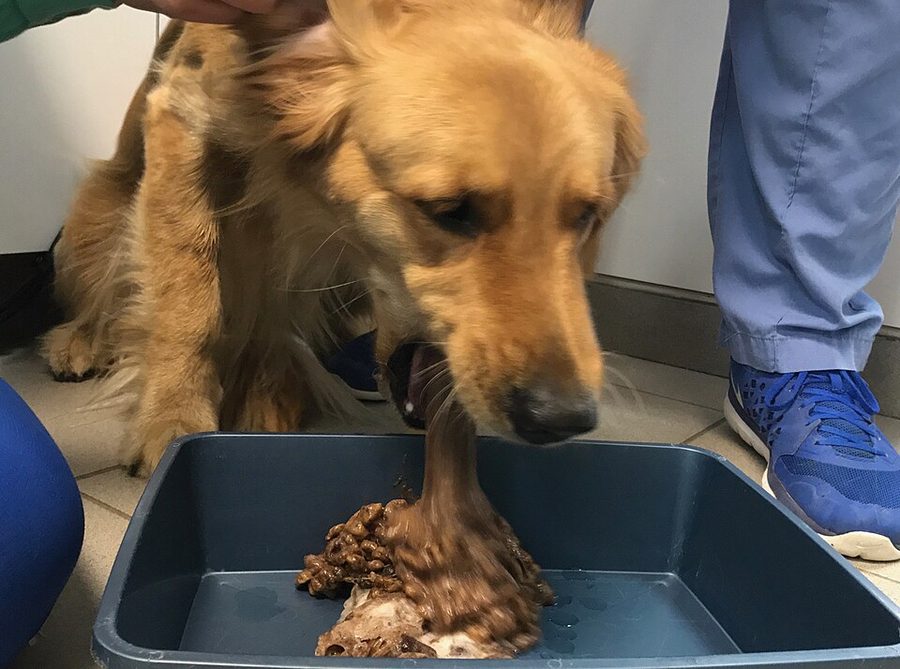
Vomiting is the forceful ejection of the contents (such as food, fluids, or debris) of the stomach and upper small intestine. It is typically preceded by other signs, such as nausea, excessive drooling, retching, and forceful contractions of the abdominal muscles and the diaphragm. Vomiting can be caused by many disorders, including digestive system disease, kidney or liver failure, pancreatitis, nervous system disorders, and ingestion of irritating substances and poisons.
Vomiting differs from regurgitation, which is a passive motion that does not require effort or contraction of the abdominal muscles. With regurgitation, the expelled food and fluid tends to be undigested and may have a cylindrical shape reflecting the shape of the esophagus. Coughing or difficulty breathing are more often associated with regurgitation than with vomiting.
Acute (Short-term) Vomiting
When a dog has been vomiting for only a short time (less than 3 to 4 days) and no other signs are present, your veterinarian’s examination may include a detailed history (including questions about your pet’s possible access to garbage or poisons), a physical examination (including the abdomen), examination of the mouth, and a rectal examination (checking for evidence of blood or eating inappropriate items). X-rays are also appropriate for most vomiting dogs because they can help identify life-threatening diseases, such as an ingested foreign object. Blood, urine, and fecal tests may also be appropriate. If nothing of significance is found, treatment to relieve signs may be all that is needed.
Generally, the treatment for short-term vomiting requires withholding food and limiting access to water for 24 hours. However, water should never be withheld unless the dog is receiving supplemental fluids either under the skin (subcutaneously) or directly into the blood vessels (intravenous). Dehydration and other internal abnormalities are expected with vomiting, and withholding water can worsen these effects. Dehydrated animals and animals with kidney or heart disease may require intravenous fluids during this time. If the vomiting has stopped after 24 hours, the dog may be offered small amounts (for example, a teaspoonful) of easily digested food. If no further vomiting occurs, feeding can usually be slowly resumed. Follow the treatment directions provided by your veterinarian carefully. Providing too much or too little water or food during this time can hurt your pet.
Chronic (Long-term) Vomiting
Long-term vomiting, vomiting that occurs more often than once or twice daily, and vomiting accompanied by blood, abdominal pain, depression, dehydration, weakness, fever, weight loss, or other signs requires a more detailed examination. In addition to blood, fecal, and urine tests as well as x-rays of the digestive system, endoscopic evaluation and biopsy of the stomach and small intestine may be required to determine the nature of the disease. In addition, abdominal ultrasound, computed tomography (CT), magnetic resonance imaging (MRI), or other specialized tests may be necessary.
Treatment for long-term vomiting is directed at elimination of the cause, if it can be identified. In addition, your veterinarian may need to treat conditions such as dehydration, electrolyte (salt) imbalances, and acid-base disorders that may have developed. Drugs to control vomiting can be prescribed for animals with persistent vomiting, dehydration, and weakness. Your veterinarian will evaluate your pet’s overall condition before prescribing any medication or treatment.
Frequently asked questions
Vomiting dog?
The Merck Veterinary Manual covers this in the article linked on this page. Vomiting is the forceful ejection of the contents (such as food, fluids, or debris) of the stomach and upper small intestine. It is typically precede… If your dog is unwell, contact your veterinarian — this page is educational, not a diagnosis.
Vomiting dog treatment?
The Merck Veterinary Manual covers this in the article linked on this page. Vomiting is the forceful ejection of the contents (such as food, fluids, or debris) of the stomach and upper small intestine. It is typically precede… If your dog is unwell, contact your veterinarian — this page is educational, not a diagnosis.
Vomiting dog remedy?
The Merck Veterinary Manual covers this in the article linked on this page. Vomiting is the forceful ejection of the contents (such as food, fluids, or debris) of the stomach and upper small intestine. It is typically precede… If your dog is unwell, contact your veterinarian — this page is educational, not a diagnosis.